

Free AI code review tools compared
What a free tier of an AI code reviewer actually gets you — and what to check before you trust it with your main branch. A factual tour of the landscape, including us.
Key Takeaways
- Public vs Private Scoping: Many "free" tiers restrict usage strictly to open-source public repositories.
- Seat Creep vs Flat Allowances: Enterprise tools force seat-based upgrades, whereas developer-focused tools provide monthly review quotas.
- Signal vs Noise Filtering: Free linters catch AST syntax; specialized AI reviewers catch authorization and injection logic flaws.
- Data Retention Guarantees: Verify whether vendors store your private code or train models on submitted pull request diffs.
Free AI code review tools are automated developer tools that provide pull request analysis, security scanning, and bug detection without requiring upfront software licenses. However, what vendors mean by "free" varies dramatically.
This guide provides an objective map of the current landscape: review quotas, repository privacy boundaries, integration models, and security guarantees.
What "free" means across the market
Almost every AI code reviewer offers a free tier, but no two services measure allowances the same way:
- Public vs. Private Repositories: Tools like CodeRabbit provide generous free reviews for open-source public repositories, but gate private team repos behind seat pricing.
- Time-Limited Trials vs. Free Forever: Several vendors advertise "free plans" that expire after 14 days, converting to mandatory monthly subscriptions.
- Credit-Based Metering: Platforms like Greptile use consumption-based credits with no traditional seat fees, charging per review depth.
- Keyless GitHub Apps: CodePeel provides 30 monthly reviews across unlimited public and private repositories without requiring custom API keys.
Free tier comparison matrix
| Vendor | Free Tier Scope | Private Repos Included | API Key Required | Primary Target | Dedicated Alternative Page |
|---|---|---|---|---|---|
| CodePeel | 30 reviews / mo | Yes (Unlimited) | No | Solo devs & small teams | Pricing Overview |
| CodeRabbit | Free for Public Repos | Paid Plan Required | No | Large engineering orgs | CodeRabbit Alternative |
| Cursor BugBot | Bundled in Paid Cursor | No standalone free | No | Cursor editor power users | Cursor BugBot Alternative |
| GitHub Copilot | Enterprise add-on | Paid Plan Required | No | GitHub ecosystem teams | Copilot Review Alternative |
| Greptile | 1-dev Starter credits | Yes (Metered) | Optional | Multi-repo context orgs | Greptile Alternative |
| Qodo (Codium) | Individual dev tier | Limited allowance | Optional | Test-driven teams | Qodo Alternative |
| Sourcery | Free open-source tier | Paid for private | No | Python & JS clean code | Sourcery Alternative |
The current tool landscape
CodePeel — Solo developers and agile GitHub teams
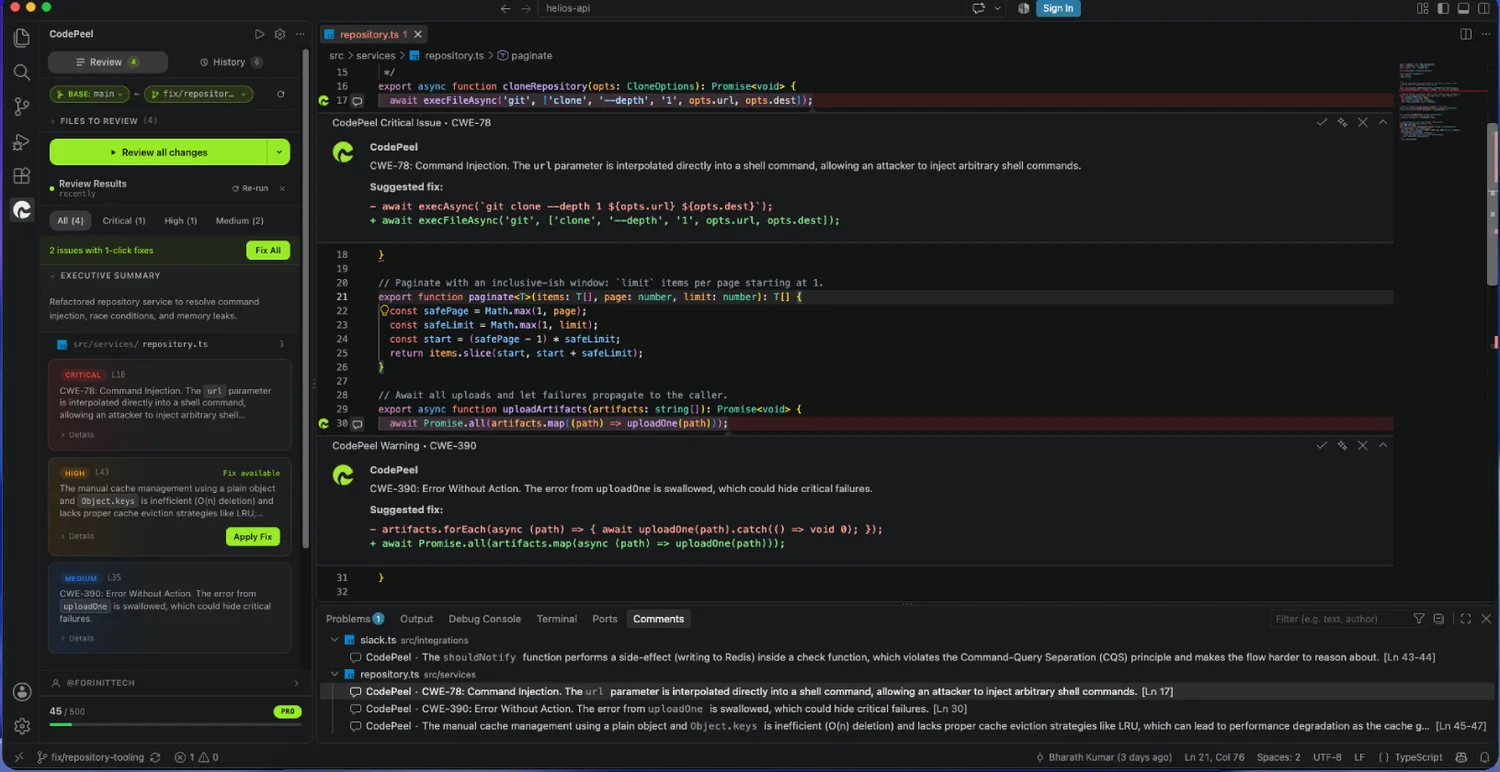
CodePeel is tailored specifically for developers who ship alone or in lean teams without peer review bandwidth. The free tier is permanently free: 30 reviews per month on unlimited public and private repositories. It runs the complete review engine—flags critical bugs, security vulnerabilities (CWE-89, CWE-798), and architecture flaws—with zero API key setup.
Paid plans starting at $9.99/mo introduce auto-fix PR generation and pre-merge quality gates. Code is analyzed ephemerally in memory and never retained for training.
CodeRabbit
The most prominent enterprise name in AI code reviews. Its free tier focuses on public open-source projects. For private commercial development, pricing shifts to seat-based subscriptions starting at $24/user/month. It offers comprehensive walkthrough summaries and conversational agent features. Read our full side-by-side analysis in CodeRabbit Alternative for Solo Devs and Small Teams.
Cursor BugBot
Cursor's built-in code reviewer is bundled inside paid Cursor subscriptions rather than offering an independent free web service. For developers seeking standalone PR reviews that work across any editor without paid Cursor subscriptions, compare trade-offs in Cursor BugBot Alternative for Code Review.
GitHub Copilot Code Review
GitHub's native review features operate within paid GitHub Copilot enterprise subscriptions. While integrated directly into GitHub's UI, it lacks automated fix pull request workflows and zero-retention privacy switches. Review detailed comparisons in GitHub Copilot Code Review Alternative.
Greptile
Greptile focuses on full-codebase context, mapping relationships across multiple microservices. Instead of seat subscriptions, it operates on a consumption credit model ($1 per review credit). If your team prioritizes cross-repo dependency indexing over lightweight diff scanning, see Greptile Alternative for Solo Devs and Small Teams.
Qodo (formerly CodiumAI)
Qodo emphasizes test generation and code integrity alongside code reviews. Its free tier offers individual developer access with strict monthly review caps. For a detailed breakdown of review noise filtering versus test generation, read Qodo Alternative for Solo Devs and Small Teams.
Sourcery
Sourcery began as a Python refactoring tool and expanded into multi-language PR review. Its free tier serves open-source repositories with limited rulesets. Read our comparative analysis in Sourcery Alternative for Solo Developers.
Key evaluation criteria before trusting a vendor
- Verify Private Repository Terms: Ensure free tier allowances do not quietly demand open-sourcing your code.
- Demand Zero-Retention Privacy: Review vendor data retention policies. Sensitive code must never be utilized to fine-tune shared foundation models.
- Test Real-World Signal-to-Noise: Hand competing reviewers a seeded test diff containing known vulnerabilities. To run a scientific blind trial, follow our framework in How to Benchmark an AI Code Reviewer.