
CodePeel vs Greptile: whole-repo context vs critical-only signal.
Greptile indexes your entire codebase and reviews every PR with that context — powerful for large, mature repositories. CodePeel reviews the diff with surrounding code and reports only critical bugs, security issues, and design flaws. Greptile wins on repo-wide understanding; CodePeel wins on signal density and price per review.
Updated October 2026 · Written by the CodePeel team · Every claim about Greptile links to Greptile’s own pages, so you can verify it.
At a glance
| Fact | CodePeel | Greptile |
|---|---|---|
| Free tier | 30 reviews/mo, unlimited public + private repos | Starter: 1 active developer, ~50 credits/mo, unlimited repos |
| Paid pricing | Pro $9.99/user/mo · Max $24.99/mo unlimited | Pro: $1 per credit, no seat fees — a base review costs 1 credit |
| Pricing model | Monthly review allowance | Usage-based credits |
| Review context | The diff with surrounding code | A whole-codebase index |
What is CodePeel?
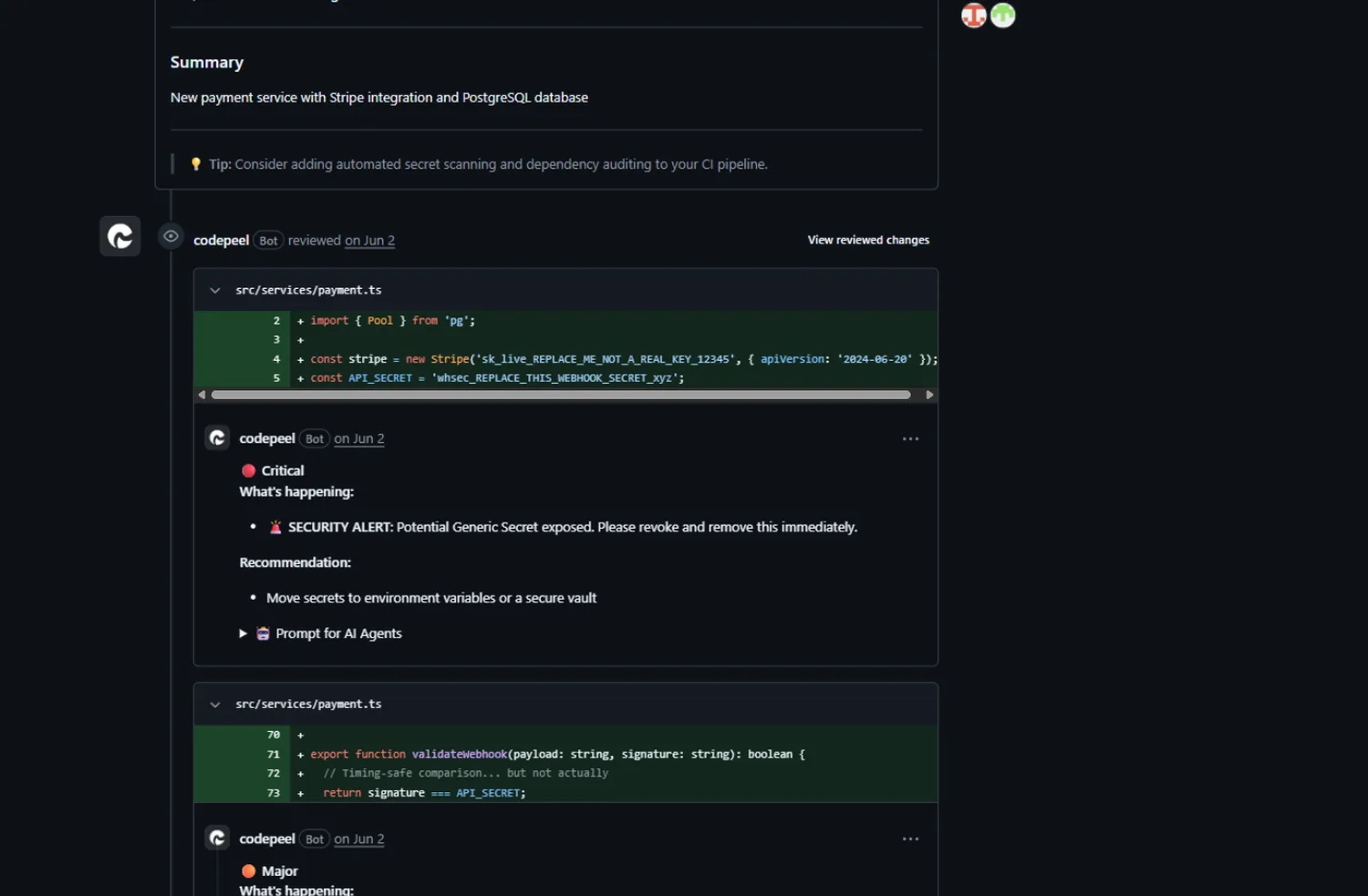
CodePeel is an AI code reviewer for GitHub. Install the GitHub App and it reviews new pull requests for critical bugs, security vulnerabilities, and design flaws — findings land on the affected line with a suggested fix, you can ask @codepeel about any finding, and on Pro it can open a separate pull request with the fix applied. A VS Code extension and an MCP server are included in every tier, and the free plan covers 30 reviews a month on unlimited public and private repositories.
What is Greptile?
Greptile builds a searchable index of your whole codebase — cross-file relationships included — and uses it to review pull requests, answer codebase questions from Slack or your IDE, and catch regressions that span files. It is built for teams with large, established codebases.
CodePeel vs Greptile, dimension by dimension
| Dimension | CodePeel | Greptile |
|---|---|---|
| Free tier | 30 reviews/mo, unlimited public + private repos | Starter: 1 active developer, ~50 credits/mo, unlimited repos |
| Paid pricing | Pro $9.99/user/mo · Max $24.99/mo unlimited | Pro: $1 per credit, no seat fees — a base review costs 1 credit |
| Pricing model | Monthly review allowance | Usage-based credits |
| Review context | The diff with surrounding code | A whole-codebase index |
| Platforms | GitHub | GitHub, GitLab, Bitbucket |
| Codebase Q&A | Ask @codepeel on the PR | Slack and IDE codebase chat |
| Editor access | VS Code extension included | IDE extensions available |
| Agent access | MCP server included, all tiers | API and integrations |
| Self-hosted | No | Available on enterprise plans |
Sources: codepeel.com/pricing · www.greptile.com/pricing. Plans change often in this market — verify both before deciding.
Where Greptile wins and falls short
Greptile’s strengths
- Whole-codebase context — catches cross-file and cross-repo regressions
- Codebase Q&A from Slack and the IDE, not just PR comments
- Platform breadth: GitHub, GitLab, and Bitbucket
- SOC 2 compliance with a self-hosted option for enterprises
- Strong engineering blog and documentation
Greptile’s weaknesses
- The credit model caps monthly review volume on lower tiers
- The free Starter plan is limited to one active developer
- The biggest advantages show up on large, mature codebases — less so on greenfield repos
- Costs scale with review volume — deeper Plus and Apex reviews cost 3–10 credits
Where CodePeel wins and falls short
No comparison written by a vendor is neutral, so the weaknesses are here too.
CodePeel’s strengths
- Per-review cost is a fraction of seat-based pricing at small-team scale
- Free tier covers unlimited private repositories for any team size
- Critical-only findings keep the review readable
- VS Code extension and MCP server included in every tier
CodePeel’s weaknesses
- No whole-repo index — regressions that span distant files can be missed
- GitHub only, while Greptile covers GitHub, GitLab, and Bitbucket
- No Slack codebase Q&A or self-hosted deployment
The verdict: choose CodePeel if… choose Greptile if…
Choose CodePeel if You are a small GitHub team that wants critical bugs and security issues surfaced cheaply and readably — without paying for a codebase index you may not need yet.
Choose Greptile if You maintain a large, established codebase where regressions span files, your team asks “why is it built this way?” daily, or you need GitLab/Bitbucket and self-hosting.
Frequently asked questions
Which free tier is better — CodePeel’s or Greptile’s?
CodePeel’s free tier covers 30 reviews a month on unlimited public and private repositories for the whole account. Greptile’s free Starter plan is limited to one active developer with around 50 credits per month — enough to evaluate on a personal project, less so for a team.
What is the main difference?
Context model. Greptile indexes the entire codebase so every review carries whole-repo understanding. CodePeel reviews the diff with its surrounding code and optimizes for critical-only signal. Whole-repo context is stronger for sprawling codebases; diff-focused review is faster, cheaper, and quieter.
Which is cheaper for a team of five?
Greptile Pro is usage-based: $1 per credit, with a base review costing 1 credit and deeper reviews 3–10. Five developers doing 50 base reviews a month pay about $50; heavier volume scales up from there. CodePeel Pro is $9.99 per user ($50 for five, 500 reviews) or Max at $24.99 flat for unlimited reviews.
Does CodePeel match Greptile’s codebase chat?
Not exactly. CodePeel’s conversation happens on the pull request — ask @codepeel about any finding — plus the VS Code extension and MCP tools. Greptile’s Slack/IDE codebase Q&A is a broader product surface that CodePeel does not try to replicate.
Can I migrate from Greptile?
Install the CodePeel GitHub App and new pull requests get reviewed immediately. Because CodePeel does not need an indexing period, first reviews land within minutes of installation.
Does either tool self-host?
Greptile offers self-hosted deployment on enterprise plans. CodePeel runs as a hosted GitHub App and does not offer self-hosting.
More comparisons
- Best AI code review tools (2026) — All eight tools in one table — pricing, strengths, weaknesses, best-for verdicts.
- CodePeel vs CodeRabbit — Agentic teams and multi-platform governance versus critical-only signal.
- CodePeel vs Qodo — A compliance platform versus a zero-setup critical-only reviewer.
Try the diff-focused reviewer.
Free, on your own repos.