
CodePeel vs Qodo: compliance platform vs critical-only reviewer.
Qodo (formerly CodiumAI) is a review-and-compliance platform for engineering organizations — Jira ticket alignment, organization-wide rules, and AI test generation. CodePeel is a lightweight GitHub reviewer for teams that want critical bugs and security issues flagged immediately, without configuring a governance system first.
Updated October 2026 · Written by the CodePeel team · Every claim about Qodo links to Qodo’s own pages, so you can verify it.
At a glance
| Fact | CodePeel | Qodo |
|---|---|---|
| Free tier | 30 reviews/mo, unlimited public + private repos | No permanent free tier — 14-day trial; free for qualified open-source projects |
| Paid pricing | Pro $9.99/user/mo · Max $24.99/mo unlimited | Pro Team $30/mo flat for up to 30 users (unlimited reviews) · Enterprise custom |
| Pricing model | Monthly review allowance | Subscription plus credit packs |
| Review focus | Critical bugs, security issues, design flaws | Quality, compliance, and process coverage |
What is CodePeel?
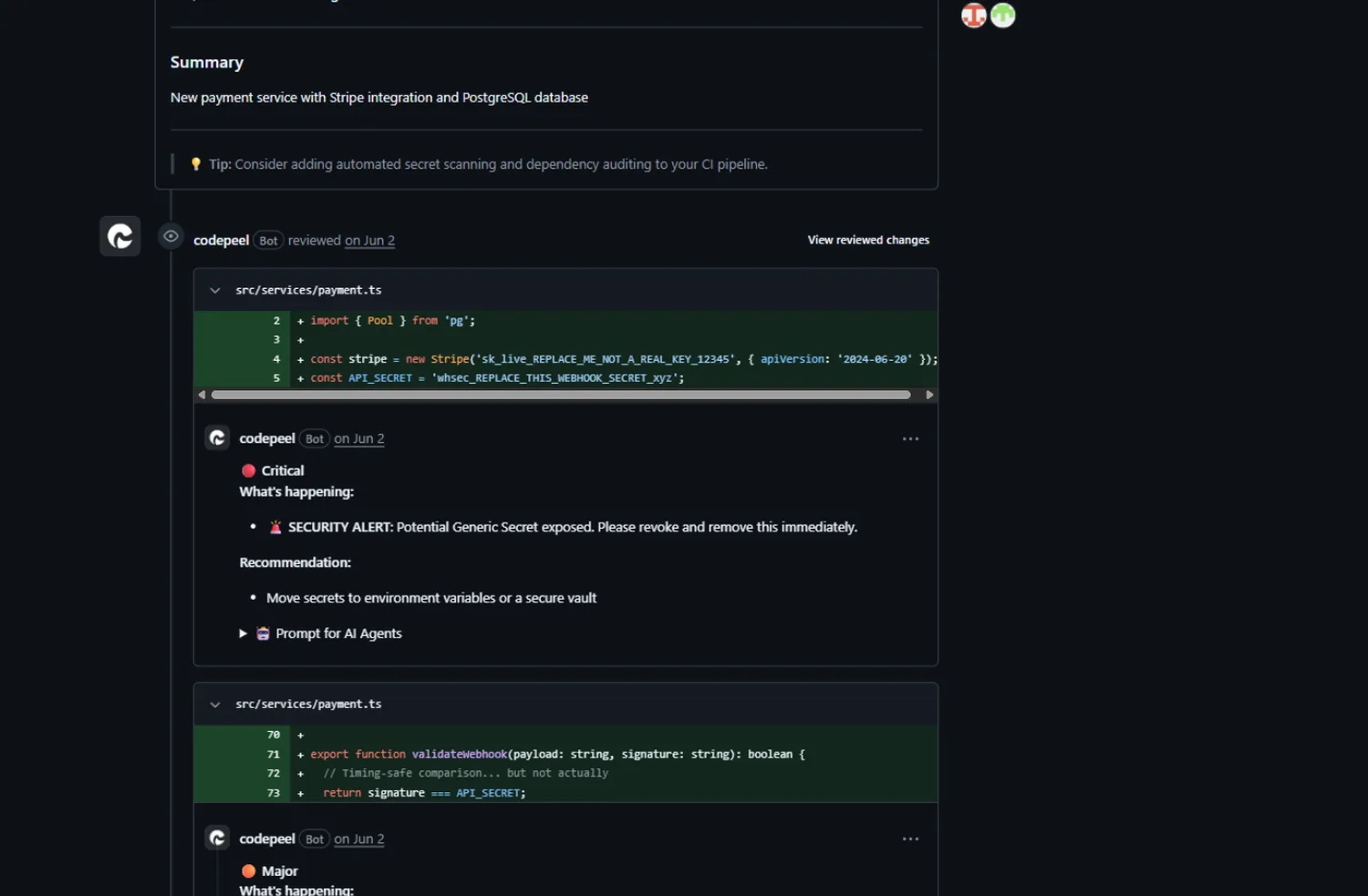
CodePeel is an AI code reviewer for GitHub. Install the GitHub App and it reviews new pull requests for critical bugs, security vulnerabilities, and design flaws — findings land on the affected line with a suggested fix, you can ask @codepeel about any finding, and on Pro it can open a separate pull request with the fix applied. A VS Code extension and an MCP server are included in every tier, and the free plan covers 30 reviews a month on unlimited public and private repositories.
What is Qodo?
Qodo focuses on review quality and process: AI agents review pull requests against organizational rules, check whether changes actually match their Jira tickets, and generate tests (Qodo Cover). It supports GitHub, GitLab, and other platforms, and its Pro Team plan is a flat monthly price.
CodePeel vs Qodo, dimension by dimension
| Dimension | CodePeel | Qodo |
|---|---|---|
| Free tier | 30 reviews/mo, unlimited public + private repos | No permanent free tier — 14-day trial; free for qualified open-source projects |
| Paid pricing | Pro $9.99/user/mo · Max $24.99/mo unlimited | Pro Team $30/mo flat for up to 30 users (unlimited reviews) · Enterprise custom |
| Pricing model | Monthly review allowance | Subscription plus credit packs |
| Review focus | Critical bugs, security issues, design flaws | Quality, compliance, and process coverage |
| Ticket alignment | No | Jira compliance checks |
| Rules | @codepeel learn: heuristics + repo rules | Organization-wide rules engine |
| Test generation | No | Qodo Cover |
| Platforms | GitHub | GitHub, GitLab, and more |
| Setup | Install the GitHub App — minutes | Configuration for org workflows |
Sources: codepeel.com/pricing · www.qodo.ai/pricing/. Plans change often in this market — verify both before deciding.
Where Qodo wins and falls short
Qodo’s strengths
- Jira compliance checks — PRs graded against their tickets
- Organization-wide rules engine for consistent review standards
- AI test generation with Qodo Cover
- Multi-platform support beyond GitHub
- Enterprise-grade process and audit features
Qodo’s weaknesses
- Governance-first design is overhead a small team does not need
- Enterprise tier required once the team passes 30 users
- Requires configuration before the process benefits appear
- Broader feedback style needs tuning to stay focused
Where CodePeel wins and falls short
No comparison written by a vendor is neutral, so the weaknesses are here too.
CodePeel’s strengths
- Zero configuration — install the app and reviews start
- Free tier covers unlimited private repositories
- Critical-only signal tuned for readability
- Flat pricing: $9.99 Pro or $24.99 unlimited Max
- VS Code extension and MCP server included in every tier
CodePeel’s weaknesses
- No compliance features — no Jira alignment or audit trails
- No test generation
- GitHub only, while Qodo supports more platforms
The verdict: choose CodePeel if… choose Qodo if…
Choose CodePeel if You are a solo developer or small GitHub team that wants critical bugs and security issues caught now — not a review process to design, configure, and enforce.
Choose Qodo if You run an engineering organization with compliance requirements, ticket-driven development, and the budget for a review platform plan.
Frequently asked questions
Is CodePeel free where Qodo is not?
Yes — CodePeel’s free plan covers 30 reviews a month on unlimited public and private repositories. Qodo states it does not offer a permanent free tier: a 14-day trial with unlimited reviews, free access for qualified open-source projects, and a Pro Team plan at $30/month flat for up to 30 users with unlimited reviews. Verify at qodo.ai/pricing.
What is the main difference?
Scope. Qodo is a quality and compliance platform: reviews graded against Jira tickets, org-wide rules, test generation. CodePeel does one thing — flag critical bugs, security vulnerabilities, and design flaws on GitHub pull requests — and stays out of your process.
Can I migrate from Qodo?
Install the CodePeel GitHub App on your repositories and reviews begin on the next pull request. There is no ruleset to recreate unless you want one; repository rules and @codepeel learn: heuristics can be added later.
Which tool fits a five-person startup?
If you run ticket-driven development with compliance needs, Qodo’s platform earns its configuration cost. If you merge fast and want a second pair of eyes on critical issues, CodePeel’s zero-setup free tier is the faster path.
Does CodePeel integrate with Jira?
No. CodePeel reviews code, not process. If PR-to-ticket compliance is a requirement, that is a genuine Qodo strength.
More comparisons
- Best AI code review tools (2026) — All eight tools in one table — pricing, strengths, weaknesses, best-for verdicts.
- CodePeel vs CodeRabbit — Agentic teams and multi-platform governance versus critical-only signal.
- CodePeel vs Greptile — Whole-codebase indexing versus diff-focused review.
Try the zero-setup reviewer.
Free, on your own repos.