
AI code review without an API key
You do not need to buy model access, manage keys, or wire a CI pipeline to get a serious review on every change. Here is how keyless AI review works and what it covers.
Key Takeaways
- Eliminate Credential Overhead: Avoid managing expensive OpenAI or Anthropic API keys inside GitHub Actions secrets.
- Predictable Monthly Quotas: Protect against unexpected bill spikes caused by large PR diffs or automated bot loops.
- Zero-Setup GitHub App Integration: Install via GitHub Marketplace in 60 seconds; no YAML pipeline scripts or self-hosted runners needed.
- Unified Multi-Surface Token: One account allowance covers GitHub pull request checks, local editor reviews in VS Code, and agentic workflows over MCP.
Keyless AI code review is an architectural integration model where the code review platform manages foundation model credentials, token consumption billing, and model versioning internally, eliminating the need for developers to provision their own LLM API keys.
Bring-Your-Own-Key (BYOK) is common among early developer tools: you generate an API key with an AI provider, paste it into CI repository secrets, monitor monthly token invoices, and debug prompt timeouts yourself. For solo developers and fast-moving teams, this introduces unnecessary maintenance friction.
This guide explains how keyless review works, what security checks it provides, and the practical trade-offs between keyless architectures and BYOK pipelines.
The hidden maintenance tax of BYOK review
Operating a bring-your-own-key review system introduces operational liabilities:
- Unpredictable billing volatility: Model APIs charge per processed token. A single 2,000-line dependency refactor during a busy sprint can trigger unexpected cloud invoice spikes.
- Credential leakage risk: Storing high-privilege LLM keys in CI/CD secrets matrices increases security blast radius (CWE-798).
- Model maintenance overhead: LLM providers frequently deprecate model endpoints or adjust temperature behaviors, requiring continuous prompt tuning.
Keyless vs Bring-Your-Own-Key comparison
| Architecture Dimension | Keyless (CodePeel Managed) | Bring-Your-Own-Key (BYOK) |
|---|---|---|
| Setup Time | 60 seconds (1-click GitHub App install) | 30–60 minutes (CI YAML + Secret provisioning) |
| Cost Predictability | Fixed monthly review allowance (30 Free / 500 Pro) | Variable per-token metered invoice |
| API Key Leakage Risk | Zero (No LLM keys stored in your repository) | High (Long-lived secret stored in CI variables) |
| Model Optimization | Calibrated prompt weights & zero-temp tuning | Manual temperature and context-window tuning |
| Multi-Surface Access | Shared across GitHub, VS Code, and MCP | Requires copying keys across developer laptops |
| Self-Hosted LLM Support | No (Hosted enterprise infrastructure) | Yes (Supports custom local Ollama / vLLM endpoints) |
How CodePeel's keyless architecture works
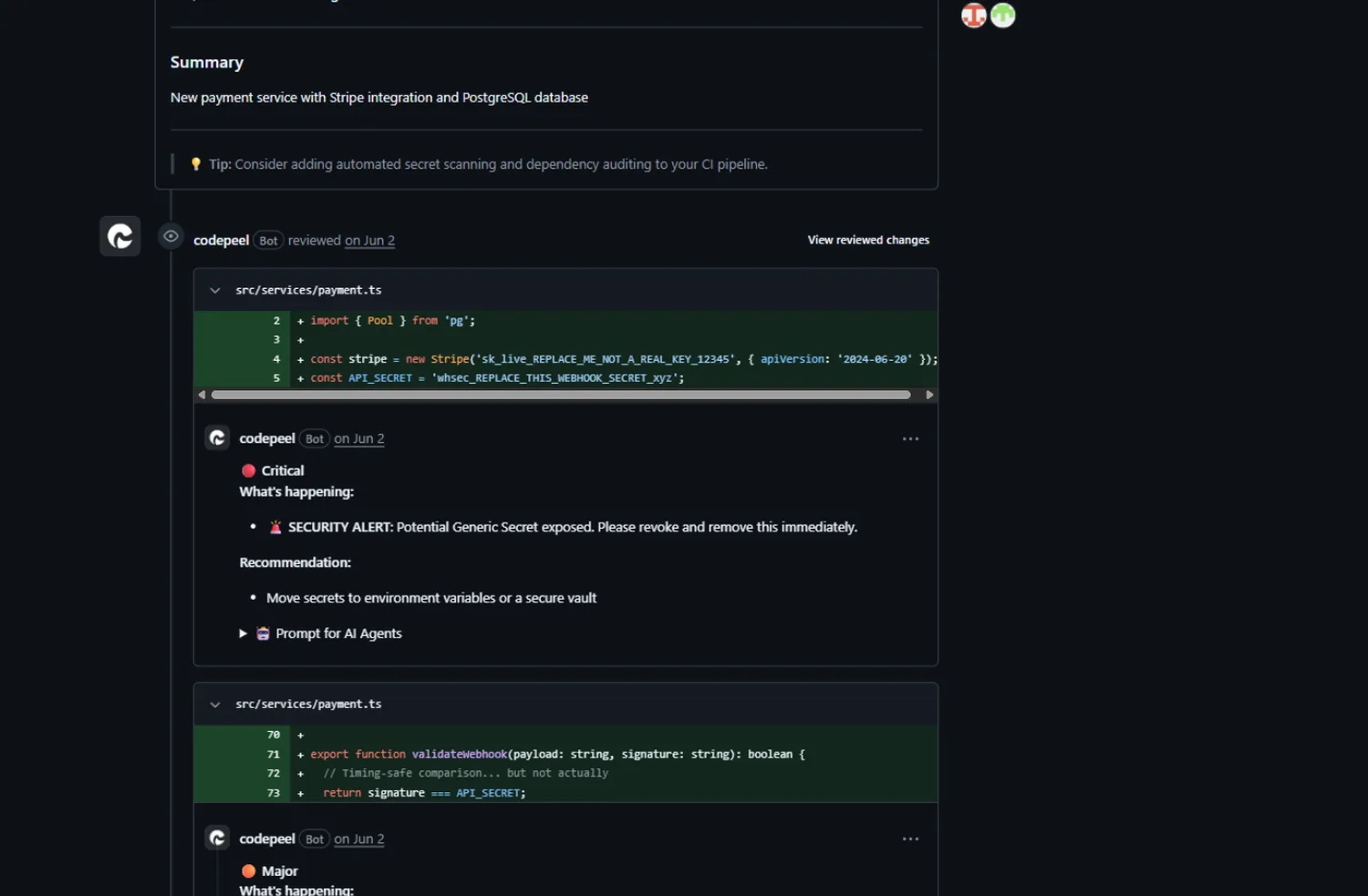
With CodePeel, the machine learning infrastructure is managed as an integrated cloud service. You install the official GitHub App, select your repositories, and open a pull request. Review webhooks process through our optimized inference cluster, posting structured findings directly to your commit diff.
The same managed entitlement covers all developer surfaces:
- GitHub Pull Requests: Automated review pass on every push.
- Local Editor: Pre-commit inline reviews via the VS Code extension.
- AI Coding Agents: In-flow prompt reviews over our Claude Code MCP server.
What the review covers out of the box
Keyless does not mean lightweight. Every pull request receives a comprehensive dual-layer evaluation:
- Functional Defect Detection: Unhandled promise rejections, race conditions, and null boundary exceptions.
- OWASP Security SAST: Hardcoded credential checks, SQL injection detection, and webhook verification flaws as detailed in How CodePeel's OWASP Security Scanning Works.
- Architectural Regression Warnings: Duplicated logic and unindexed queries.
- Automated Fix PRs: Automatically opens fix branches for verified findings with Auto-Fix PR Generation.
When BYOK makes sense
A bring-your-own-key architecture remains appropriate in specific enterprise scenarios:
- Strict Data Sovereignty: Highly regulated banking or defense environments requiring private on-premise model deployments.
- Fine-Tuned Proprietary Models: Organizations deploying customized in-house foundation models trained on private internal frameworks.
For independent developers and modern product teams, a keyless platform provides immediate productivity without infrastructure maintenance.
To test how effectively automated reviewers catch planted defects without configuration, follow our evaluation framework in How to Benchmark an AI Code Reviewer.