

How to Benchmark an AI Code Reviewer (Without Fooling Yourself)
A methodology for evaluating AI code reviewers on your own repositories: building a seeded diff corpus, blind runs, precision versus recall on planted findings, and the metrics that marketing demos skip.
Every vendor of AI code review tools publishes impressive marketing demonstrations. A cherry-picked diff, a clean finding, and an automated pull request comment that spots the planted vulnerability instantly. Yet when connected to your private repository, performance often degrades into hallucinated nitpicks and missed edge cases. The reality is that vendor demos hide two vital dimensions: false positive rates and missed critical defects.
Key Takeaways
- Build a Seeded Corpus: Evaluate reviewers against 15–20 real pull requests containing known historical production incidents and clean control diffs.
- Measure Recall AND Precision: A reviewer claiming 95% defect recall is unusable if it floods pull requests with 20 style nits per commit.
- Test for Run-to-Run Determinism: Because generative LLMs can be stochastic, execute duplicate blind passes over the same diff at temperature zero.
- Calculate Actionability: The highest-value metric is whether findings provide line-accurate, copy-paste-ready fixes that preserve system intent.
Benchmarking an AI code reviewer is the empirical measurement of an automated review engine's precision, recall, and false-positive rate across a controlled, seeded diff corpus. Rather than trusting synthetic benchmarks like SWE-bench in isolation, teams must evaluate reviewers on their own repository architecture.
This guide outlines our repeatable testing methodology. Run it across any AI reviewer you are evaluating before connecting automated webhooks to production repositories.
Why vendor demos cannot be trusted
Vendor marketing diffs are engineered to succeed. The planted bug matches the reviewer's exact prompt keywords, the repository lacks legacy complexity, and reviewers omit the dozens of commits scanned without comment. An isolated finding in a demo is an anecdote, not empirical verification.
A second issue is distribution congruence: an AI code reviewer evaluated against code generated by the same model architecture appears flawless because both systems share vocabulary and training assumptions. Real codebases—with multi-tenant boundaries, legacy database abstractions, and subtle concurrency locks—test actual generalization.
Step 1: build a seeded diff corpus
Assemble 15 to 25 merged pull requests from your team's historical repository records. Divide the evaluation diffs into three distinct groups:
- Historical incident commits (Real Defect Corpus): Extract the git diff immediately preceding a documented production bug fix. The expected finding is whatever your post-mortem incident report identified.
- Planted architectural vulnerabilities: Inject specific, labeled weaknesses into real repository code:
- Clean control pull requests: Include 5 to 8 changes with zero defects, refactors, or documentation edits. A reviewer that hallucinates findings on clean code creates developer fatigue.
Seeded Evaluation Corpus (20 Pull Requests)
┌──────────────────────────────────────────────┐
│  7 Historical Production Bugs (Post-Mortem)  │ ──► Evaluates Real-World Recall
├──────────────────────────────────────────────┤
│  8 Planted OWASP & Architecture Defects      │ ──► Evaluates Zero-Day Detection
├──────────────────────────────────────────────┤
│  5 Clean Control Diffs (Zero Defects)        │ ──► Evaluates False Positive Rate
└──────────────────────────────────────────────┘
Step 2: run blind evaluations and test reproducibility
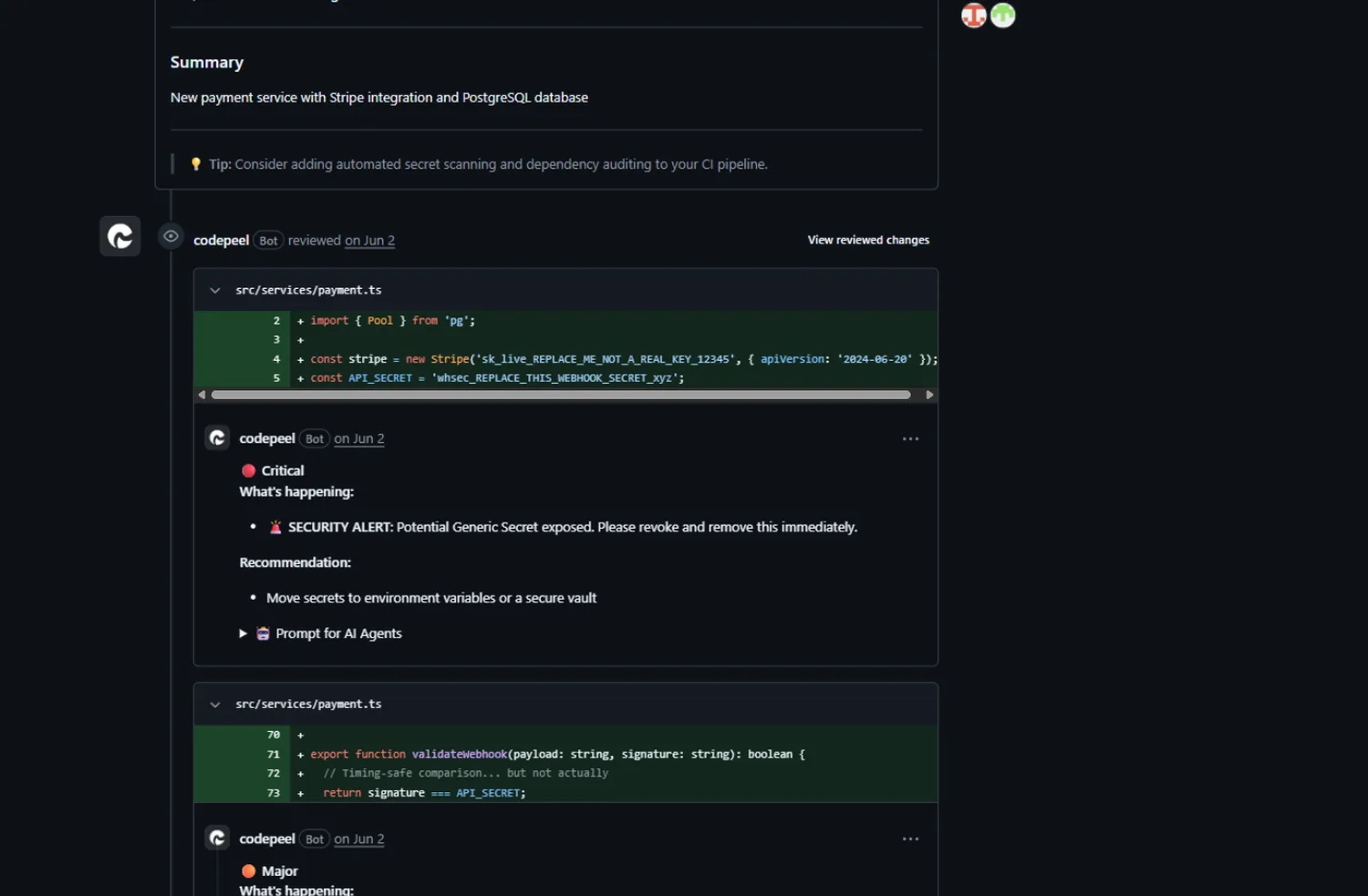
Feed every competing tool the identical diff corpus under blind conditions. Mask tool names in review transcripts before scoring to eliminate reviewer bias:
- Unified input state: Review the diff exclusively rather than granting indexing access to secondary branches. Freeze dependency locks so all tools review identical syntax.
- Duplicate runs for determinism: Generative models are inherently probabilistic. Run each tool twice against the same diff. A vulnerability flagged on Run 1 but missed on Run 2 indicates high variance rather than reliable protection.
- Log silence accurately: Record both caught defects and clean passes. For clean control pull requests, count every comment produced as a false alarm.
Step 3: calculate the 4 core benchmark metrics
Summarize review performance using an empirical scoring matrix:
| Metric | Formula / Calculation | Target Threshold | Why It Matters |
|---|---|---|---|
| Defect Recall | Caught Planted Defects / Total Planted Defects | ≥ 85% | Measures vulnerability catch rate |
| Precision | Valid Defect Findings / Total Reported Findings | ≥ 75% | Measures signal-to-noise ratio |
| False Alarm Rate | Hallucinated Findings / Clean Control PRs | ≤ 0.2 / PR | Prevents developer notification fatigue |
| Fix Actionability | Valid Copy-Paste Fixes / Total Flagged Findings | ≥ 60% | Speeds remediation without research |
F1-Score = 2 × (Precision × Recall) / (Precision + Recall)
Read the actual review commentary to evaluate cognitive clarity. Does the explanation explain why the code fails within your specific system architecture? Does it provide an automated patch that can be applied directly, such as CodePeel's auto-fix PR generation? A concise reviewer with 80% recall and verified patches delivers higher productivity than a verbose tool with 95% recall that buries developers in style advice.
Step 4: continuous benchmark tracking
A benchmark is not a one-time exercise. As underlying LLMs release new checkpoints, prompt weights and temperature settings drift. Maintain continuous calibration:
- Turn every incident into a test case: Whenever a production bug escapes review, convert the pre-fix diff into a permanent regression test. Run your AI reviewer against it. If the tool misses the defect, adjust repository review learnings or inject custom YAML rules.
- Monitor monthly false-positive trends: Track the volume of dismissed review comments on active pull requests. If noise exceeds 20%, tighten pre-merge quality gates to filter advisory comments.
Internal benchmarking at CodePeel
At CodePeel, we evaluate our review engines using this identical framework. Our deterministic regex engine is judged on absolute precision: it must achieve 100% recall on hardcoded secret fallbacks and webhook serialization flaws without exception. Our model-driven SAST engine is measured continuously against 200+ seeded enterprise diffs covering the OWASP Top 10.
We do not market synthetic benchmarks because proprietary diffs cannot be externally verified. We recommend engineering teams run this methodology directly on their own pull request history.
To start testing, review our vulnerability checklist in The AI-Generated Code Review Checklist and compare top engines in Best AI Code Review Tools Compared.