
The AI-generated code review checklist
Seven checks that catch what AI-generated code gets wrong: authorization, inputs, failure paths, secrets, injection, tests and design fit. Copy the list, run it on every change.
Key Takeaways
- The Plausibility Trap: AI generators produce syntactically clean code that compiles smoothly while omitting boundary and authorization checks.
- 7-Point Inspection Protocol: Enforce explicit checks across authorization, input tracing, failure paths, credentials, injection, test validity, and architectural fit.
- Negative Assertion Requirement: Generated test suites must test failure rejection paths rather than merely mirroring happy-path logic.
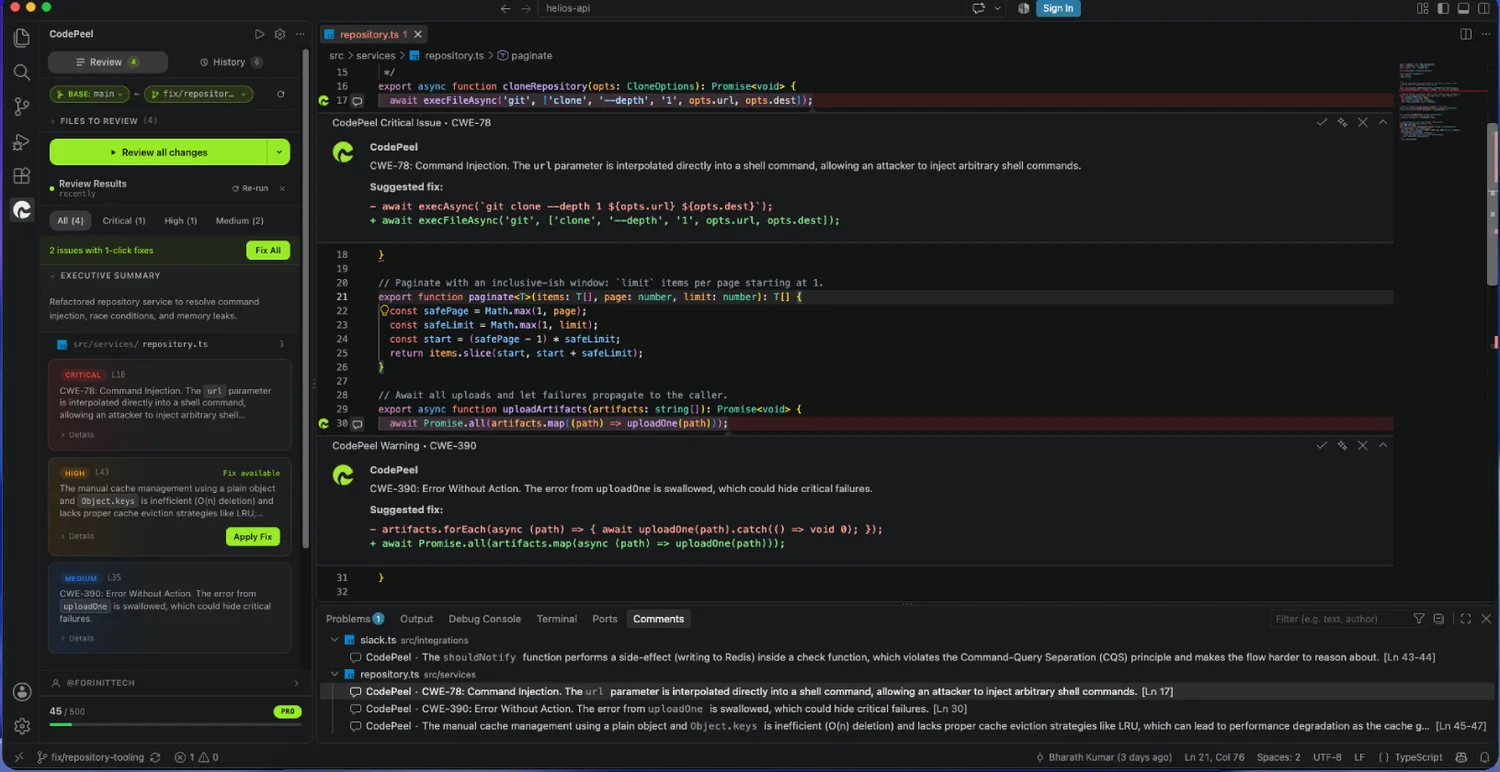
- Automated Pre-Commit Defense: Catch these 7 hazards early using the CodePeel VS Code extension.
An AI-generated code review checklist is a structured verification protocol designed to inspect code generated by artificial intelligence for subtle logic omissions, missing security boundaries, and architectural drift before merging into production.
Human programmers fail through typos, fatigue, and misread requirements. Generative coding models fail differently: they prioritize immediate local completion over architectural guardrails.
This operational checklist provides seven targeted checks to run across every AI-authored pull request diff.
Why AI-generated code demands unique inspection
Three distinct failure modes characterize model-generated pull requests:
- Unwarranted syntactic confidence: The code compiles cleanly, formats neatly, and satisfies the prompt's happy path—all while completely skipping permission checks or error timeouts.
- Local prompt myopia: The model optimizes the single function requested in the prompt, remaining blind to multi-tenant data boundaries or surrounding service contracts.
- Legacy pattern inheritance: Models trained on public code routinely reintroduce deprecated APIs and insecure practices that modern frameworks prevent by default.
The 1-sentence pre-review specification
Before reading the diff lines, state in a single sentence what the change must accomplish and who has permission to trigger it:
"An authenticated team admin can refund an invoice belonging to their organization, and all other callers must be rejected."
This sentence serves as your benchmark specification. Without an explicit rule, convincing AI code will always look finished.
The 7-point review checklist
| Inspection Area | Critical Failure Mode | Applicable Weakness | Automated Scan Check |
|---|---|---|---|
| 1. Authorization | Authenticates caller but omits ownership lookup | CWE-284 | OWASP Security Scan |
| 2. Input Taint | Untrusted parameters flow into raw queries | CWE-20 | Deterministic AST Check |
| 3. Failure Paths | Network timeouts or unhandled rejections | CWE-755 | Model Logic SAST |
| 4. Credentials | Hardcoded secrets or fallback literals | CWE-798 | Deterministic Secret Scan |
| 5. Injection | Template-literal SQL or shell execution | CWE-89 | Zero-Tolerance Gate |
| 6. Test Quality | Tests tautologically echo buggy implementation | N/A | Manual Inspection |
| 7. Architecture | Duplicated logic or crossed layer boundaries | N/A | Pre-Merge Quality Gate |
1. Authorization: Who is permitted to call this?
Verify that endpoints enforce resource ownership. Authentication confirms who the caller is; authorization verifies whether they may execute the action. AI generators routinely verify sessions while forgetting to restrict lookups by tenant or user ID.
2. Input Tracing: Follow external values to their sinks
Map every external input parameter—query arguments, body payloads, HTTP headers, and environment variables. Verify that inputs are sanitized before reaching database queries, file systems, or process shells.
3. Failure Paths: What occurs when dependencies throw?
Inspect every database query, cache call, and third-party webhook. Ask what occurs when services time out or return empty arrays. Check for unhandled promise rejections, empty catch blocks, and unbounded retry loops.
4. Secrets and Credentials: Check for hardcoded fallbacks
Scan diffs for API keys, tokens, or private secrets. AI code often inserts temporary fallback strings like process.env.API_KEY || "dev-token-123". CodePeel detects and flags these patterns automatically as detailed in How CodePeel's OWASP Security Scanning Works.
5. Injection Surfaces: Prevent raw string interpretation
Ensure all database queries use parameterized prepared statements. Disallow raw string concatenation inside SQL statements, shell execution commands, or HTML outputs.
6. Test Validity: Do tests assert behavior or echo code?
Generated test suites frequently assert the exact flawed output generated by the function. Require tests that assert explicit rejection cases—such as unauthorized access attempts or malformed inputs.
7. Architectural Fit: Does the change respect system boundaries?
Verify that the generated change does not duplicate existing helper libraries or bypass the established repository data access layer.
Automating checklist enforcement
Running this checklist manually takes 2–3 minutes per pull request. To automate verification across your repository:
- Intercept vulnerabilities pre-commit using the CodePeel VS Code extension.
- Auto-generate pull request fixes with Auto-Fix PR Generation.
- Block non-compliant merges automatically using Pre-Merge Quality Gates.
- Measure your review coverage against our methodology in How to Benchmark an AI Code Reviewer.