

CodePeel vs Sourcery: Python depth vs language-agnostic critical review.
Sourcery grew out of Python refactoring and now reviews GitHub and GitLab pull requests with fast, instant feedback — it is strongest in Python codebases. CodePeel reviews any language on GitHub with a critical-only focus and a free tier that covers private repositories, which Sourcery’s free plan reserves for open source.
Updated October 2026 · Written by the CodePeel team · Every claim about Sourcery links to Sourcery’s own pages, so you can verify it.
At a glance
| Fact | CodePeel | Sourcery |
|---|---|---|
| Free tier | 30 reviews/mo, unlimited public + private repos | Free for open-source projects |
| Pricing | Pro $9.99/user/mo · Max $24.99/mo unlimited | Pro $12/dev/mo annual ($15 monthly) · Team $24/dev/mo annual ($30 monthly) |
| Languages | Any — the review is model-driven | Python-first heritage |
| Platforms | GitHub | GitHub and GitLab |
What is CodePeel?
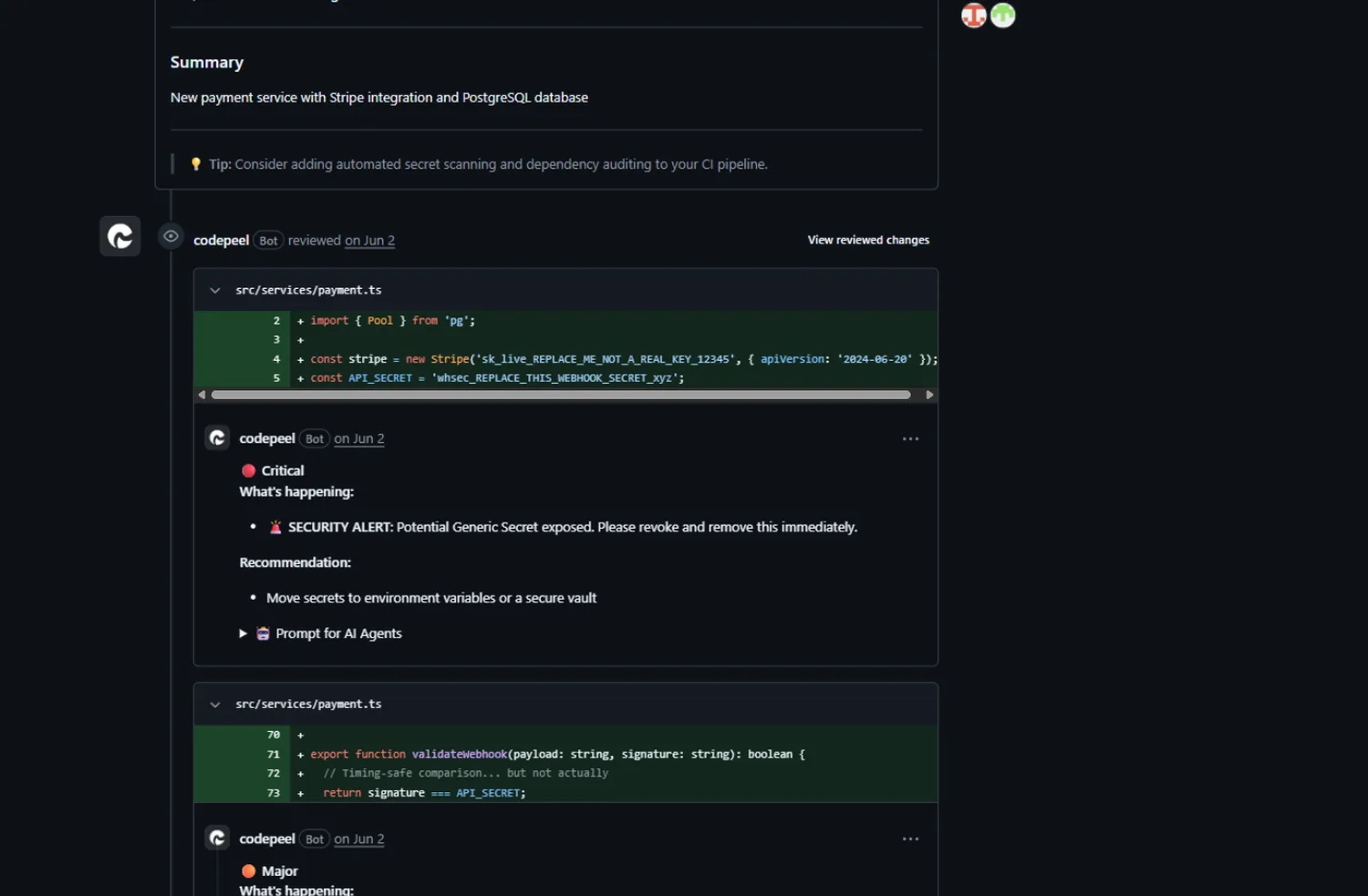
CodePeel is an AI code reviewer for GitHub. Install the GitHub App and it reviews new pull requests for critical bugs, security vulnerabilities, and design flaws — findings land on the affected line with a suggested fix, you can ask @codepeel about any finding, and on Pro it can open a separate pull request with the fix applied. A VS Code extension and an MCP server are included in every tier, and the free plan covers 30 reviews a month on unlimited public and private repositories.
What is Sourcery?
Sourcery started as a Python refactoring tool. Sourcery Review now comments on GitHub and GitLab pull requests with AI findings and near-instant feedback, and it keeps that Python heritage — refactoring suggestions are where it is deepest.
CodePeel vs Sourcery, dimension by dimension
| Dimension | CodePeel | Sourcery |
|---|---|---|
| Free tier | 30 reviews/mo, unlimited public + private repos | Free for open-source projects |
| Pricing | Pro $9.99/user/mo · Max $24.99/mo unlimited | Pro $12/dev/mo annual ($15 monthly) · Team $24/dev/mo annual ($30 monthly) |
| Languages | Any — the review is model-driven | Python-first heritage |
| Platforms | GitHub | GitHub and GitLab |
| Review style | Critical bugs, security, design flaws only | Refactoring improvements plus findings |
| Editor access | VS Code extension included | Python IDE integrations |
| Agent access | MCP server included, all tiers | Not a focus |
| Feedback speed | Minutes, findings on the line | Near-instant |
Sources: codepeel.com/pricing · sourcery.ai/pricing/. Plans change often in this market — verify both before deciding.
Where Sourcery wins and falls short
Sourcery’s strengths
- Deep Python expertise — refactoring suggestions beyond bug hunting
- Near-instant feedback on pull requests
- GitLab support alongside GitHub
- Simple, affordable per-developer pricing
Sourcery’s weaknesses
- Python-first: other languages get thinner review quality
- The free tier is limited to open-source projects
- Smaller feature surface — no MCP, limited editor coverage
- Fewer enterprise controls than the larger platforms
Where CodePeel wins and falls short
No comparison written by a vendor is neutral, so the weaknesses are here too.
CodePeel’s strengths
- Language-agnostic review — TypeScript, Python, Go, and more
- Free tier covers unlimited private repositories
- Critical-only signal with security findings on the line
- VS Code extension and MCP server included in every tier
- Auto-fix pull requests on Pro
CodePeel’s weaknesses
- No GitLab support — Sourcery covers it
- No Python-specific refactoring depth
- Slightly slower feedback than Sourcery’s instant model
The verdict: choose CodePeel if… choose Sourcery if…
Choose CodePeel if Your team ships a mix of languages on GitHub and wants one reviewer that flags critical bugs and security issues across all of them, free on private repos.
Choose Sourcery if You are a Python-centric team — especially on GitLab — that values instant refactoring-aware feedback.
Frequently asked questions
Which free tier covers more — CodePeel’s or Sourcery’s?
CodePeel’s free tier covers private repositories too; Sourcery’s Open Source plan is free forever for public repositories; private repositories need Pro at $12 per developer per month billed annually ($15 monthly), or Team at $24 per developer per month billed annually ($30 monthly) with security checks. Verify at sourcery.ai/pricing. CodePeel’s free tier covers private repositories too — 30 reviews a month, no card required.
What is the main difference?
Breadth versus depth. Sourcery is deepest in Python and offers refactoring-style improvements plus GitLab support. CodePeel is language-agnostic and focuses purely on critical bugs, security vulnerabilities, and design flaws.
Which is better for a Python-only team?
Honestly, Sourcery is a reasonable answer — its Python refactoring depth is real. Choose CodePeel instead when security findings matter as much as refactors, or when your repos include anything beyond Python.
Can I migrate from Sourcery?
Install the CodePeel GitHub App and new pull requests get reviewed immediately. If you are on GitLab, stay with a tool that supports it — CodePeel is GitHub-only today.
Does either tool support GitLab?
Sourcery supports GitHub and GitLab. CodePeel is GitHub-only — a real limitation to weigh.
More comparisons
- Best AI code review tools (2026) — All eight tools in one table — pricing, strengths, weaknesses, best-for verdicts.
- CodePeel vs CodeRabbit — Agentic teams and multi-platform governance versus critical-only signal.
- CodePeel vs Greptile — Whole-codebase indexing versus diff-focused review.
Try the language-agnostic reviewer.
Free, on your own repos.