
How to get a code review when you ship alone
You merge without a second reviewer, so nobody reads the diff before it lands. Here is how to put a real review pass on every change — what AI review catches that self-review misses, how it fits a solo workflow, and what to look for in a tool.
Key Takeaways
- Overcoming Self-Review Blind Spots: Developers read what they intended to write rather than what is actually on the page; automated reviewers evaluate syntax objectively.
- Critical-Only Signal Filtering: Solo builders cannot afford to review 60 formatting opinions; focus strictly on exploitable security risks and logic crashes.
- The 3-Point Workflow: Intercept bugs locally in your editor, in AI agent prompts over MCP, and at the final GitHub pull request merge gate.
- Zero-Retention Privacy: Ensure your code is processed in volatile memory and never retained for foundation model training.
AI code review for solo developers is an automated second-pair-of-eyes review process that inspects pull request diffs for critical bugs, security vulnerabilities, and architectural drift without requiring a human engineering team.
Solo founders and independent developers ship full-stack applications alone: payment webhooks, database migrations, authentication tokens, and complex API logic. Without a peer review step, subtle security regressions and unhandled failure branches slip into production unnoticed.
The review you can't get
Skipping code reviews is a rational short-term calculation for solo builders: hiring external contractors is expensive, peer requests take days, and features pass local manual tests. Yet risk accumulates quietly. Code that executes smoothly on the happy path often conceals hardcoded tokens in error logs, missing tenancy authorization checks, or memory leaks that surface under traffic spikes.
An automated AI code reviewer provides consistent vigilance. It inspects every pull request instantly, never tires during midnight releases, and identifies defects that self-review overlooks.
What AI review catches that self-review misses
Self-review suffers from cognitive confirmation bias: you re-read your intended mental model instead of the literal code. An automated reviewer evaluates raw syntax without preconceptions.
In real-world solo repositories, focused AI code reviewers catch three core categories:
- Critical functional bugs: Unhandled asynchronous promise rejections, null pointers on optional payload attributes, infinite retry loops, and off-by-one pagination limits.
- High-severity security flaws: SQL injection via string concatenation (CWE-89), API keys exposed in exception dumps, and unauthenticated endpoints. AI-generated code frequently produces plausible syntax that omits essential validation guardrails. Learn how these manifest in The OWASP Top 10 in AI-Generated Code.
- Architectural design drift: Duplicated business logic across modules, unindexed database queries inside loops, and broken layer boundaries.
Crucially, an effective solo reviewer suppresses minor formatting and style opinions. For a solo builder, filtering style noise is the difference between an actionable review and a muted notification.
The 3-point solo developer workflow
A robust review workflow meets developers where they build:
Step 1: Editor Pass (Pre-Commit)
└── Catch syntax & security flaws in VS Code before committing
    [Read: VS Code Integration Guide](/integrations/vs-code)

Step 2: Coding Agent Pass (In-Flow)
└── Let AI agents review staged diffs via Model Context Protocol
    [Read: Cursor Integration](/integrations/cursor) · [Claude Code](/integrations/claude-code) · [Windsurf](/integrations/windsurf)

Step 3: Pull Request Merge Gate (Pre-Merge)
└── Automated GitHub App check blocks regressions via branch protection
    [Read: Pre-Merge Quality Gates](/blog/pre-merge-quality-gates)
1. Pull requests: the automated safety net
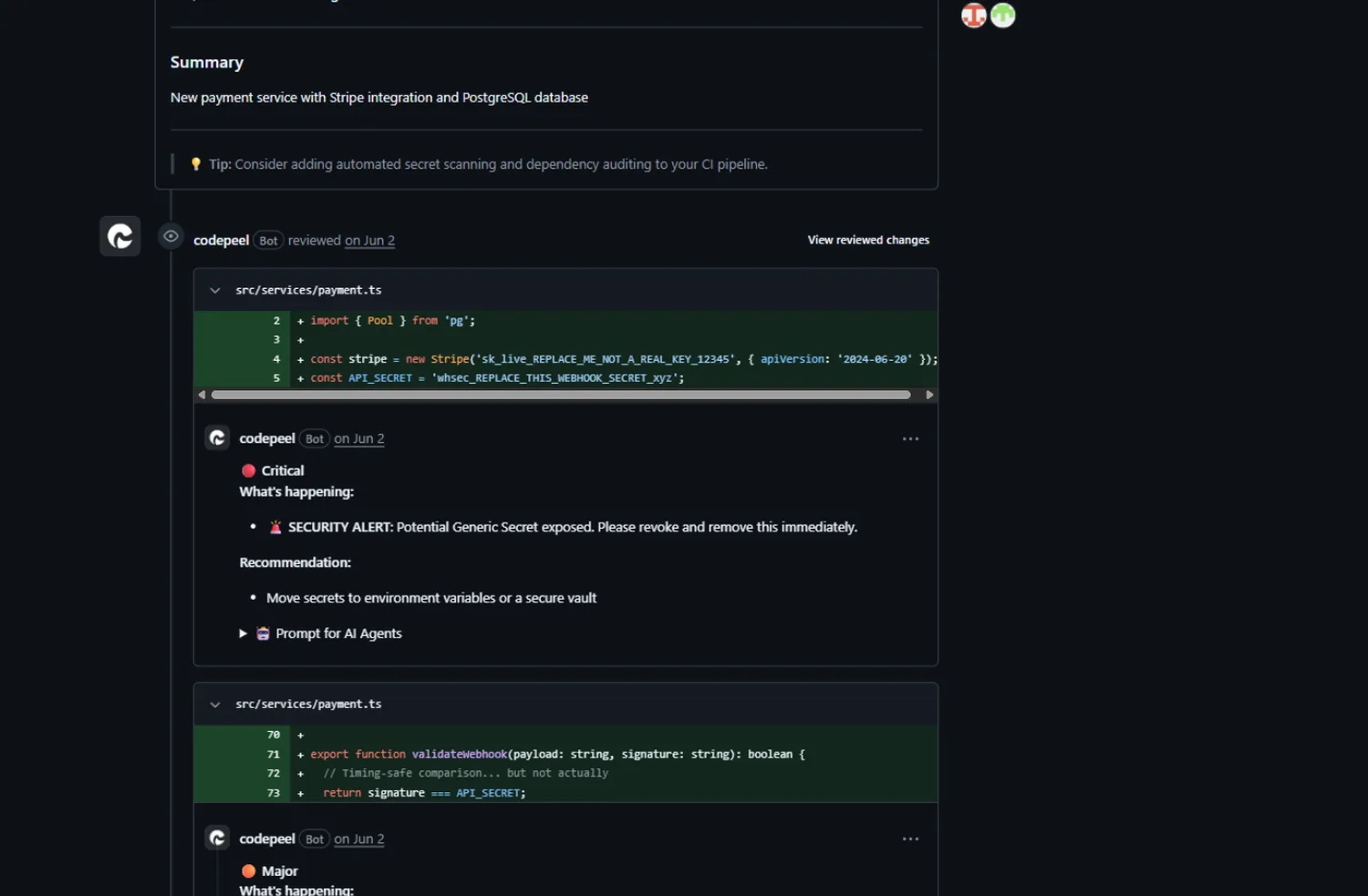
Install CodePeel as a GitHub App. Whenever you open a pull request, an automated review pass inspects the diff. Findings attach directly to modified lines with severity labels and copy-paste code patches. This pass enforces pre-merge quality gates on your repository with zero CI configuration.
2. Before you push: the local editor pass
Catching mistakes locally is faster than pushing fix commits. Using the CodePeel VS Code extension, you can review uncommitted, staged, or branch changes directly inside your editor. Findings appear as squiggles and entries in the Problems panel. Explore the mechanics in our VS Code Inline Review Walkthrough.
3. Coding agents and MCP: the in-flow pass
If you write software with modern AI coding assistants, CodePeel connects over the Model Context Protocol (MCP). Your agent can review diffs, fetch targeted patches, and re-verify before finalizing file edits:
- Connect CodePeel in Cursor to review agent-generated composer changes.
- Set up the Claude Code MCP Server for automated terminal review loops.
- Use CodePeel with Windsurf Cascade for real-time flow inspections.
Choosing an AI reviewer for solo development
When reviewing software alone, five criteria separate valuable tools from noisy toys:
| Evaluation Dimension | What to Look For | CodePeel Implementation |
|---|---|---|
| Private Repo Access | Unlimited private repository coverage on free plans | 30 reviews / mo free on unlimited private repos |
| Setup Overhead | 1-click GitHub App install with zero API key wiring | Native GitHub App installation |
| Noise Filtering | Strict suppression of formatting and cosmetic nits | Critical-only findings (Bugs, Security, Design) |
| Privacy Guarantees | Ephemeral, in-memory processing without model training | Zero-retention pipeline; read our Security Page |
| Multi-Surface Access | GitHub webhooks, VS Code extension, and MCP servers | Unified allowance across GitHub, VS Code, and MCP |
Maintaining human review agency
An automated AI reviewer inspects the diff first, but the developer retains ultimate merge authority:
- Verify explanations against your domain model: Reviewers explain line risks; you confirm whether the edge case applies to your business logic.
- Inspect automated patches before applying: Review suggested patches to ensure type signatures and imports remain coherent.
- Require automated tests alongside reviews: AI reviews detect missing logic; unit tests prove expected outcomes. Combine both before merging.
To measure how your automated tools perform on real code, apply our empirical testing corpus in How to Benchmark an AI Code Reviewer.
Frequently asked questions
Does automated code review replace automated tests?
No. Code review identifies logical edge cases and security vulnerabilities; automated test suites prove intended functional behavior. Both safety nets are complementary.
Will automated comments spam my pull requests?
CodePeel enforces strict noise-reduction gates. Stylistic commentary is suppressed, surfacing only high-severity bugs and security vulnerabilities.
How does CodePeel protect proprietary private source code?
Code submitted for review is processed ephemerally in memory and never stored, logged, or utilized to fine-tune shared machine learning models. Consult our security documentation for full architecture specifications.