

AI code review for Cursor-built changes
Cursor is great at generating large changes — and large changes are exactly what deserves a review. Connect CodePeel over MCP and get a critical-findings review of any diff without leaving your flow.
Updated October 2026 · Written by the CodePeel team · Setup takes minutes; the MCP details link to the full docs.
What this setup gives you
Cursor generates changes fast, often across many files at once. CodePeel reviews the resulting diff for critical bugs, security vulnerabilities, and design flaws — the failures the generator cannot see, because it is reviewing the code it just wrote with the same blind spot that wrote it.
Review what Cursor writes
Send any diff and the review comes back with findings for critical bugs, security vulnerabilities, and design flaws — each with severity and the affected line, so you can accept or reject with information instead of hope.
Risk explained on the line
Findings land on the exact changed line with the reason it matters, not a vague warning. Where a finding has a fix, the suggested change is ready to inspect and apply in your working tree.
Suggested fixes, then PR review
Apply suggested fixes while you are still in the file, and when you open the pull request the GitHub App reviews it again — the same engine on both ends, so the final change gets a second pass on the way in.
Setup: four steps
- Create an MCP token in CodePeel — Settings → MCP Tokens — then add the server in Cursor’s MCP settings (
npx -y @codepeelai/codepeelwithCODEPEEL_TOKENset). - Build with Cursor as usual — composer, agent, or manual edits.
- Ask Cursor to run a CodePeel review on the current changes.
- Fix what matters, then let the GitHub App review the final PR.
Configuration details, token handling, and troubleshooting live in the MCP setup guide.
What the review catches in composer output
Large multi-file generations are exactly where review pays off:
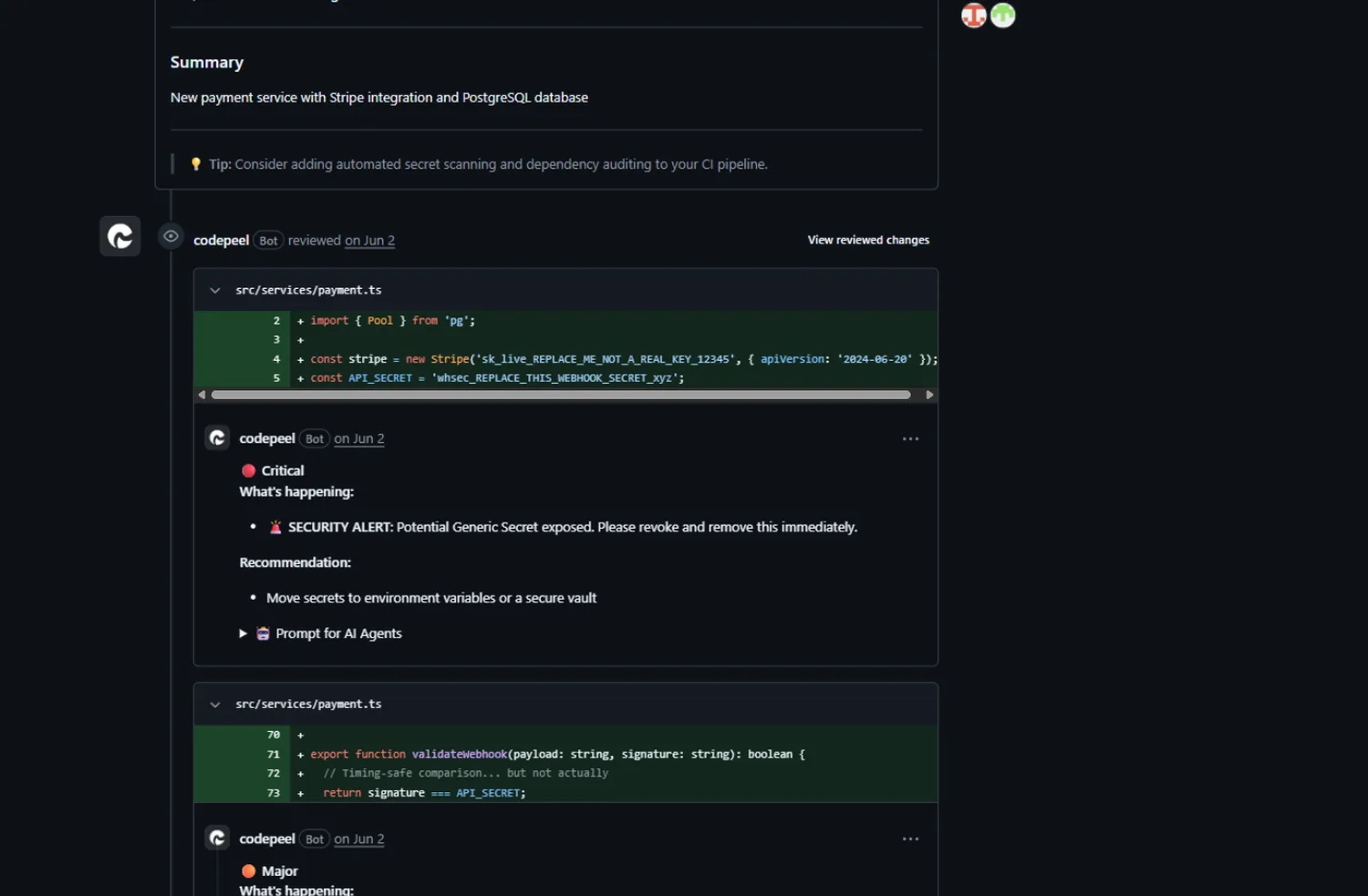
Behavior changes across files
When Cursor edits six files at once, the diff is reviewed as one change — a filter that disappeared in one file is caught against the others.
The insecure pattern the model liked
Generated code repeats patterns from training data. If the pattern is an interpolated query or a client-side secret, the security pass flags it every time it appears.
Duplication and boundary breaks
Agent refactors tend to copy logic rather than move it. The design pass flags the duplicate and points at the existing module.
Honest limits
The trade-offs, stated before you commit:
On-demand means you ask
Cursor reviews run when requested — there is no automatic pass on every completion. The automatic layer is the GitHub App on the pull request.
Model choice is ours
CodePeel owns the provider integration. You cannot pin a model version; the trade is that you never debug one either.
Reviews can be wrong
Verify findings against your code before acting. A confident finding on a wrong line is still a wrong finding.
Frequently asked questions
Does the review slow Cursor down?
No. Reviews run through the MCP server only when you ask for one — nothing intercepts or queues your completions.
Does it cover private repositories?
Yes. The free plan covers unlimited public and private repositories, and code is analyzed in memory without being stored.
What about the pull request itself?
When you open the PR, the GitHub App reviews it again with the same engine — the pre-commit pass and the PR pass share one account.
More comparisons and guides
- CodePeel vs Cursor BugBot — BugBot is Cursor’s bundled reviewer — how it compares with a standalone critical-only pass.
- Reviewing AI-generated code: the checklist — What to verify before merging agent-written changes.
- Best AI code review tools (2026) — All eight tools in one pricing table, weaknesses included.
Generate fast. Merge reviewed.
Free, on your own repos — the same review engine on MCP, in the editor, and on every pull request.